An AI talking avatar turns one photo into a lip-synced video: upload a portrait (or generate one), type what it should say and how, and Aura AI returns a talking head clip in about a minute. No camera, no actor, no editing timeline.
This tutorial covers the three-step workflow, the prompts that get natural results, how to go from 60-second clips to 10-minute training videos, and when to step up to AIGC Studio for a complete ad with script, voiceover and b-roll. Whether you are a podcaster adding visuals to audio, a marketer producing spokesperson videos or a creator running a faceless YouTube channel, the process is the same.
What Are AI Talking Avatars?
AI talking avatars (also called talking heads, AI presenters, or digital spokespersons) are computer-generated videos where a person appears to be speaking naturally. These aren't stiff, robotic animations—they're realistic videos with natural lip-sync, facial expressions, and body language that make them virtually indistinguishable from real footage.
The technology has exploded in 2025, with content creators, marketers, and educators using AI avatars for everything from podcast clips to product demonstrations. The best part? You don't need any technical skills to create them.
🎯 Perfect Use Cases for AI Talking Avatars
- Podcast Video Clips: Turn your audio podcast into engaging video content for YouTube, TikTok, and Instagram
- Social Media Content: Create attention-grabbing talking head videos for Reels, Shorts, and TikTok
- Product Demonstrations: Generate spokesperson videos explaining your products or services
- Educational Content: Build course intros, explanations, and tutorials with virtual presenters
- Marketing Videos: Create testimonial-style or announcement videos at scale
- Faceless YouTube Channels: Produce consistent content without showing your own face
Step 1: Choose Your Video Format
1The first decision you'll make is your video orientation. This matters because different platforms perform better with different formats.
Vertical Format (9:16) is perfect for:
- TikTok videos
- Instagram Reels
- YouTube Shorts
- Snapchat Spotlight
- Facebook Reels
Horizontal Format (16:9) works best for:
- YouTube main feed videos
- Podcast video clips
- LinkedIn videos
- Website embedding
- Professional presentations
Pro tip: If you're creating podcast content, go horizontal. If you're targeting short-form social media virality, choose vertical. The interface makes switching between formats instant, so you can easily create both versions of the same content.
Step 2: Create Your Perfect Avatar
2This is where the magic happens. You have two powerful options for creating your talking avatar, and both produce professional results.
Option A: Upload Your Own Image
Already have a photo you want to use? Perfect. Click "Upload Image" and select any portrait photo from your device. This works great if you:
- Want to use your own likeness
- Have professional headshots ready
- Need consistency with existing branding
- Already have images of team members or clients (with permission)
The AI will analyze your uploaded photo and prepare it for video generation, ensuring natural movement and lip-sync.
Want more control over the face than the three generated options give you? Create the portrait first in text to image with GPT Image 2.5 or FLUX 2, download it and upload it here. Front-facing, evenly lit portraits give the most accurate lip sync.
Option B: Generate with AI (Recommended)
This is where things get really interesting. Instead of using existing photos, you can describe your ideal avatar and let AI create three unique options for you to choose from.
How to write effective avatar prompts:
The key to getting great results is being specific. Instead of "a man," try:
"Professional podcast host, male in his late 20s, speaking into studio microphone, warm studio lighting, friendly and engaging expression, wearing casual button-up shirt, photorealistic, high quality"
Here's what makes a great prompt:
- Age range: "in his 30s," "young woman," "mature professional"
- Setting: "podcast studio," "office background," "neutral backdrop"
- Lighting: "warm lighting," "professional studio lights," "natural window light"
- Expression: "friendly smile," "confident," "engaging," "professional"
- Attire: "business casual," "wearing hoodie," "professional suit"
- Props: "speaking into microphone," "with headphones," "at desk"
- Style: "photorealistic," "cinematic quality," "4k detail"
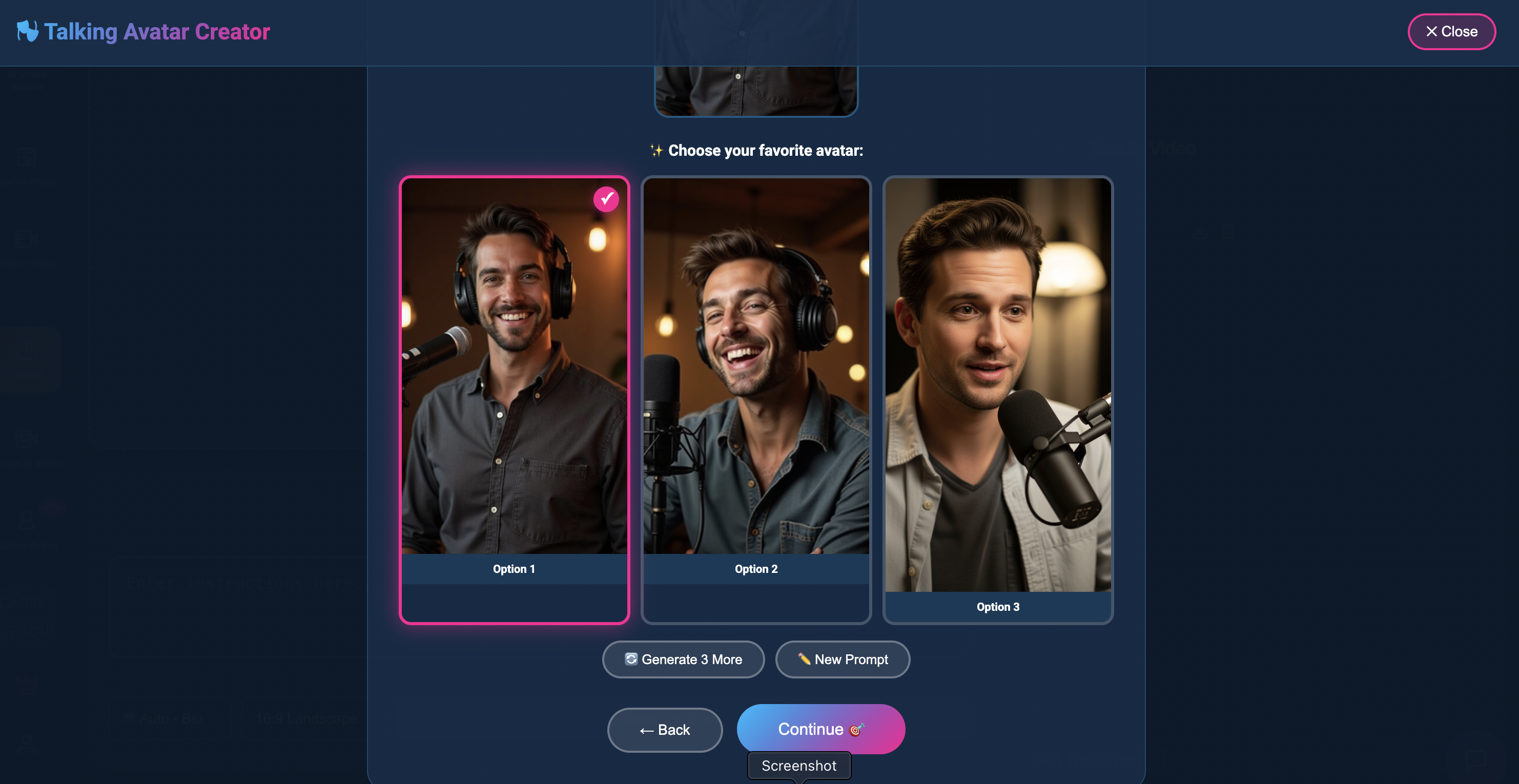
Once you hit generate, Aura AI creates three different variations of your prompt. This gives you options—maybe one has better lighting, another has a more engaging expression, or the third just "feels right" for your brand.
Don't like what you see? No problem. Click "Generate 3 More" to get completely new options, or "New Prompt" to start over with a different description. Each generation costs credits (3 credits total for three images), so you can iterate until you find the perfect avatar.
Once you've found your favorite, simply click on it. You'll see a checkmark appear, confirming your selection. Now you're ready for the final step.
Step 3: Bring Your Avatar to Life with Speech
3This is where your static image transforms into a talking video. But here's the crucial part most people miss: you're not just describing what to say—you're describing HOW to say it.
The Art of Speech Prompts
Think of this like directing an actor. You need to convey:
- The message content (what they're saying)
- The tone of voice (how they're saying it)
- The energy level (their delivery style)
- The context (the situation they're in)
Example speech prompts that work:
"Friendly podcast intro, enthusiastic and engaging tone, welcoming viewers to today's episode about artificial intelligence and creativity"
"Professional product demonstration, confident and clear voice, explaining the key features of a new software tool to potential customers"
"Casual YouTube video intro, energetic and personable style, introducing a tech review with excitement about new gadgets"
"Calming meditation guide, soft and soothing voice, leading viewers through a five-minute breathing exercise"
Notice how each prompt includes:
- The format/context (podcast intro, product demo, YouTube intro)
- Tone descriptors (enthusiastic, confident, energetic, calming)
- Voice quality (engaging, clear, personable, soothing)
- Content direction (what they're actually talking about)
Advanced Tips for Natural Results
- Match the tone to your avatar: If you generated a professional-looking spokesperson, write formal speech. If your avatar looks casual, keep the speech conversational.
- Include pacing cues: Words like "energetically," "slowly," "quickly" help control delivery speed.
- Specify emotions: "Excited," "serious," "empathetic," "humorous" create different feels.
- Consider your audience: B2B content? Professional tone. Gen Z audience? Keep it casual and authentic.
Once you've crafted your perfect speech prompt, click "Generate" and watch the magic happen.
What Happens Next: The Generation Process
The moment you hit generate, the Talking Avatar Creator closes and your video immediately appears in your video list with a progress indicator. This is Aura AI's intelligent processing system at work.
Here's what's happening behind the scenes:
- Image Analysis: The AI examines your selected avatar image, mapping facial features and structures
- Speech Synthesis: Your prompt is converted into natural-sounding speech with appropriate tone and pacing
- Lip-Sync Generation: Advanced algorithms synchronize mouth movements perfectly with the audio
- Expression Animation: Natural facial expressions and micro-movements are added for realism
- Video Rendering: Everything is compiled into your final high-quality video file
Talking avatars on Aura AI are rendered by video models with native speech and lip sync: Kling AI 3.0 gives the most accurate mouth movement, Google Veo 3.1 pairs realistic faces with clean audio, and Seedance 2.0 keeps a character consistent across longer scripts.
The entire process typically takes 30-60 seconds depending on video length and current server load. You'll see real-time progress updates, and once complete, you can preview, download, or share your creation immediately.
Cost and Credit System
Understanding the pricing structure helps you plan your content creation efficiently:
Avatar Generation (Step 2):
- Generating 3 avatar options = 3 credits (1 credit per image)
- You can regenerate as many times as needed
- Uploading your own photo = 0 credits
Video Creation (Step 3):
- Creating the final talking video = credits based on your plan
- Credit cost varies by plan tier (Starter, Pro, Premium)
- One video = one credit for most standard-length content
Pro tip: If you're on a budget, upload your own images to save credits, then spend them on the final talking avatar video.
Advanced Strategies for Maximum Impact
Creating Content Series
One of the most powerful uses of AI talking avatars is creating consistent series content:
- Generate your avatar once with the perfect look for your brand
- Download and save the avatar image from your first video
- Upload that same avatar for future videos to maintain consistency
- Vary only the speech prompts to create a series of episodes
This gives you a "virtual host" for your content that viewers will recognize across videos, building familiarity and trust.
Repurposing Content Across Platforms
Create once, publish everywhere:
- Generate horizontal (16:9) version for YouTube and LinkedIn
- Create vertical (9:16) version of the same content for TikTok, Reels, and Shorts
- Adjust speech prompts slightly for each platform's audience style
This strategy lets you maximize reach with minimal additional effort.
A/B Testing for Viral Content
Since generating avatars is quick and affordable:
- Create 2-3 different avatar styles for the same message
- Post them at different times to the same platform
- Track which style generates more engagement
- Double down on what works
Long talking-avatar videos (10 minutes and more)
The 60-second workflow above is the fast path for social clips. The same avatar engine also handles long-form: paste a script of several minutes and the avatar delivers it in one continuous take, up to 10 minutes and more, with the lip sync held for the whole duration. A few numbers to plan with:
- Script length: about 150 words of script equal one minute of natural speech, so a 10-minute video needs roughly 1,500 words. Break long scripts into short paragraphs; the pacing follows your punctuation.
- Credits: long videos are charged per second of output, so a 37-second product demo costs a fraction of a 10-minute training module, and only successful generations are charged.
- Voice: the voice is generated from your text. The tool suggests a voice that matches the portrait (gender, age, energy) and you can override it. Type the script in the target language and the avatar speaks it with native pronunciation: English, Spanish, French, German, Chinese, Arabic and dozens more.
- Output: HD video in 16:9 or 9:16, delivered without watermark, ready for YouTube, an LMS or a landing page.
For anything past 10 minutes, generate the script in chapters and join them in the AI video editor, where you can also cut in slides, screen recordings or AI b-roll between talking segments.
Training videos use case
Training and onboarding content is where talking avatars pay off fastest: it changes often, it has to exist in several languages, and nobody wants to book a studio every time a policy is updated. The workflow teams use on Aura AI:
- Write the module script once. Keep each module under two minutes (about 300 words) so it stays easy to update and easy to watch.
- Pick a consistent presenter. Upload a real team member's portrait (with permission) or generate a virtual trainer with GPT Image 2.5, then reuse the same image for every module so the trainer is recognisable across the course.
- Generate, then localise. Translate the script and regenerate: same avatar, same visuals, new language, no re-recording and no voice actors per market.
- Update by editing text. When a process changes, edit the paragraph and regenerate that module only; the rest of the course stays untouched.
- Assemble the course. Add screen recordings, slides or AI b-roll around the talking segments in the AI video editor, export without watermark and upload to your LMS or a private YouTube playlist.
Typical modules built this way: employee onboarding, compliance refreshers, software how-to guides, customer education and course intros. Consistency is the point: the same presenter, tone and framing across fifty modules and five languages, produced in an afternoon instead of weeks of studio time.
Common Mistakes to Avoid
1. Vague Avatar Prompts
❌ Bad: "A person talking"
✅ Good: "Professional female podcast host in her 30s, warm studio lighting, engaging smile, speaking into vintage microphone, wearing business casual attire"
2. Generic Speech Descriptions
❌ Bad: "Talk about the product"
✅ Good: "Enthusiastic product demonstration, confident and clear voice, highlighting three key features that solve customer pain points"
3. Ignoring Platform Requirements
Don't create horizontal videos for TikTok or vertical videos for YouTube main feed. Match your format to the platform.
4. Not Saving Successful Avatars
When you create an avatar that performs well, save that image! Upload it for future videos to maintain consistency.
5. Overcomplicating Speech Prompts
Keep prompts focused. One clear message with one tone works better than trying to pack multiple ideas into a single video.
Real-World Success Stories
Podcast to Video Conversion
Sarah, a business podcast host, was struggling to grow her YouTube channel because she only had audio content. Using Talking Avatar Creator, she:
- Generated a professional avatar that matched her brand aesthetic
- Created video versions of her best podcast episodes
- Posted them as YouTube content and Instagram Reels
- Grew her YouTube subscribers by 340% in 3 months
Marketing Agency Scale
A marketing agency needed to create spokesperson videos for 20 different clients. Instead of hiring actors and booking studios:
- They generated unique avatars matching each client's brand identity
- Created customized messaging for each business
- Delivered all 20 videos in one day instead of two weeks
- Saved over $15,000 in production costs
Educational Content Creator
Mark wanted to start a faceless YouTube channel teaching programming but was camera-shy. He:
- Created a friendly, approachable tech educator avatar
- Used the same avatar across 50+ tutorial videos
- Built a consistent brand identity without ever appearing on camera
- Now runs a successful channel with 100K+ subscribers
The Future of AI Talking Avatars
We're just scratching the surface of what's possible with AI video generation. As the technology evolves, we're seeing:
- Longer videos: 10-minute presentations are already possible (see the long-form section above), and the ceiling keeps rising
- More natural movements: Hand gestures, body language, and subtle animations
- Voice cloning: Using your own voice with any avatar
- Real-time generation: Creating videos instantly instead of waiting for rendering
- Interactive avatars: AI hosts that can respond to live questions
Aura AI is committed to staying at the cutting edge of these developments, continuously improving the Talking Avatar Creator with new features and capabilities.
Getting Started Today
Ready to create your first AI talking avatar? Here's your action plan:
- Sign in to Aura AI and open the web app
- Look for the "Talking Avatar" button in your dashboard (marked with a NEW badge)
- Decide on your format based on where you'll post the content
- Choose between upload or generate for your avatar
- Write a detailed speech prompt with tone and context
- Generate and wait about 60 seconds for your video
- Download, share, and repeat
The hardest part is getting started. Once you create your first talking avatar and see how easy and powerful it is, you'll wonder how you ever created content without it.
💡 Pro Tip: Start Simple
Your first avatar doesn't have to be perfect. Start with a basic prompt, generate your video, and learn from the result. Each video you create will teach you what works best for your audience and style. The key is to start creating today rather than waiting for the "perfect" setup.
Frequently Asked Questions
Do I need any technical skills to use this?
Absolutely not. If you can type a description and click a button, you can create professional AI talking avatars. The entire process is designed for non-technical users.
Can I use these videos commercially?
Yes! Videos created with Aura AI can be used for commercial purposes, including marketing, advertising, and client work. Check your plan's terms for specific usage rights.
How realistic are the avatars?
Very realistic. The AI uses advanced models to create natural lip-sync, facial expressions, and micro-movements that make avatars nearly indistinguishable from real video footage.
Can I use the same avatar multiple times?
Yes! Save your generated avatar image and upload it for future videos to maintain consistency across your content series.
What languages are supported?
Type the script in the language you want spoken. The voice engine covers English, Spanish, French, German, Chinese, Arabic and dozens more with native pronunciation, and the lip sync follows the generated audio in every language.
How long can the videos be?
From a few seconds to 10 minutes and more. Credits are charged per second of output, so a 15-second social clip costs little and a long training module scales with its length. See the long-form section above for script planning.
What if I don't like the generated avatars?
Click "Generate 3 More" for new options, or "New Prompt" to try a different description. You can iterate as many times as needed (credits permitting) until you find the perfect avatar.
Conclusion: Your Content Creation Revolution Starts Now
Creating professional video content used to require expensive equipment, technical expertise, and significant time investment. Talking Avatar Creator changes all of that.
In less time than it takes to make coffee, you can generate professional talking head videos that would have cost thousands of dollars and days of production time just a few years ago. Whether you're a podcaster, marketer, educator, or content creator, this tool gives you the power to scale your video production without scaling your costs or complexity.
The creators who win in 2025 and beyond won't be the ones with the biggest budgets or fanciest equipment. They'll be the ones who embrace tools like AI talking avatars to create more content, test more ideas, and connect with audiences in new ways.
Your first video is waiting to be created. What are you going to say?
If you want to go beyond a single talking head and produce a complete UGC-style ad — avatar plus auto-written script, native voiceover, b-roll and product shots — open AIGC Studio and generate the full video from a short brief.
Create Your First AI Talking Avatar
Join thousands of creators using Aura AI to generate professional video content in seconds.
Start Creating Now